
Autonomous Mobile Robot (AMR)
An autonomous mobile robot (AMR) is a floor-mounted transport vehicle designed for in-plant material handling that moves autonomously within its environment without the need for fixed guide lines. It uses sensors to map its surroundings and continuously recalculates its route. If it encounters an obstacle, it navigates around it on its own rather than stopping in front of it.
How an Autonomous Mobile Robot navigates
SLAM (Simultaneous Localization and Mapping) forms the basis for autonomous navigation. The method solves two tasks simultaneously: The robot uses sensor data to design a map of its surroundings and, at the same time, determines its own position within that map. Both processes occur continuously while the robot is moving.
The data is provided by a combination of several sensor types:
- Laser scanners (LiDAR) capture the contours of walls, shelves, and machines and provide the reference for localization.
- Cameras and 3D sensors detect people, load carriers, and obstacles that are not parts of the map.
- Odometry and inertial sensors measure the distance traveled and help determine the position between two scans.
Using this data, the software calculates a path to the destination and continuously compares it with the stored map. If the environment changes, it adapts the path: If a pallet is blocking the aisle, the robot selects an alternate route. If the warehouse layout changes, a new mapping is all that’s needed—no structural modifications such as magnetic tracks or induction loops are required.
What Autonomous Mobile Robots Are Used For
AMRs handle internal material transport between the storage, production, and mounting areas, as well as between individual mounting lines, stations, or machines—that is, routine transport tasks that were previously performed by employees manually, using hand pallet trucks, or forklifts.
- Material supply: Just-in-time supply to assembly lines and workstations.
- Machine loading: Automatic supply of raw parts and removal of finished parts.
- Container transport: Circulation of KLTs, trays, and plastic containers between storage and production.
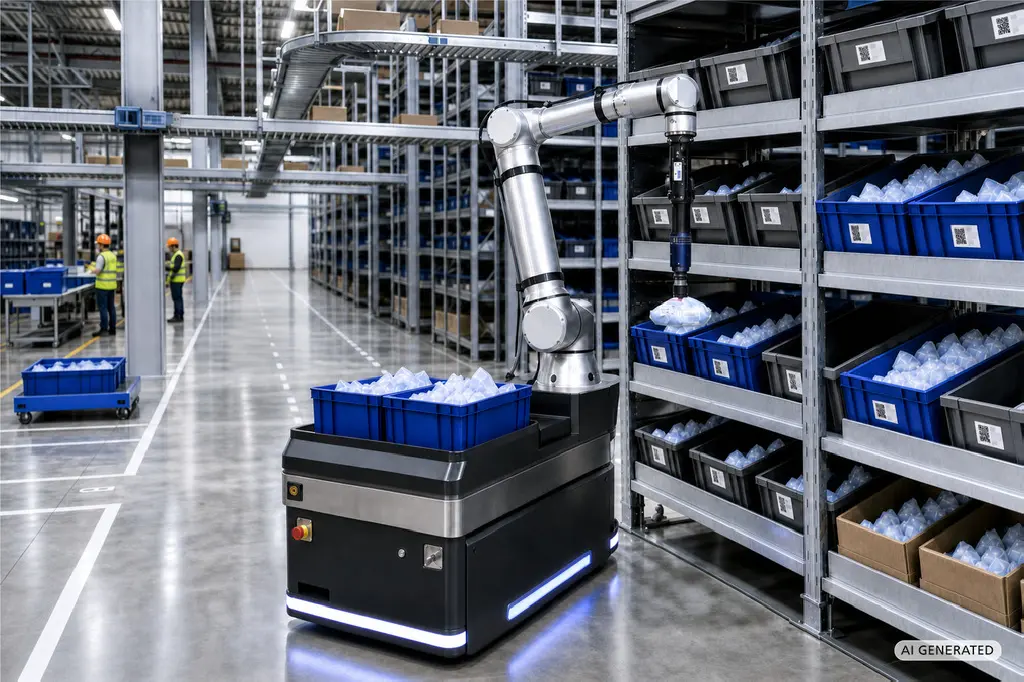
- Order Picking: Transport of order bins through the storage area as well as item picking—through a connection with a robotic arm, this also includes the precise retrieval of individual items from the shelf.
- Intra-plant transport: Connection of geographically separated areas over a length of distances.
Related terms
Frequently asked questions
Are an Autonomous Mobile Robot (AMR) and a mobile robot the same thing?
An Autonomous Mobile Robot (AMR) and a mobile robot are not the same thing, since “mobile robot” serves as an umbrella term for all driverless industrial trucks.
Within this group, the AMR constitutes a specialized subgroup with a high degree of autonomous navigation intelligence and the ability to freely choose its route. The VDI Technical Committee and the VDMA now use “mobile robotics” as a common umbrella term for all driverless systems.
What is the difference between an Autonomous Mobile Robot (AMR) and an Unmanned Transport Vehicle (FTF)?
The main difference between an Autonomous Mobile Robot (AMR) and a Driverless Transport Vehicle (FTF) lies in their navigation behavior and degree of autonomy. While an AMR calculates its routes independently and navigates around obstacles flexibly, a traditional FTF follows rigid, predetermined paths and stops when it encounters obstacles.
How do Autonomous Mobile Robots (AMRs) work safely alongside people?
Autonomous Mobile Robots (AMR) work safely alongside people thanks to integrated personal safety laser scanners, which create dynamic safety zones in front of the vehicle. If a person approaches, the robot automatically slows down and comes to an immediate stop if the person gets too close.
Particularly relevant from a safety perspective are transfer stations, where employees manually remove or place load carriers, as well as travel paths that also serve as walkways for people.
What standards apply to the safe operation of AMRs?
The two primary standards governing the safe operation of Autonomous Mobile Robots (AMRs) are DIN EN ISO 3691-4 and VDI 2510 Part 2.
The DIN EN ISO 3691-4 standard specifies the fundamental safety requirements for driverless industrial trucks and their systems. The VDI 2510 Part 2 guideline is a supplement that further describes the machine safety requirements for driverless transport systems and mobile robots throughout their entire life cycle—from planning to the start of operations to ongoing operation.
What is a mobile manipulator?
A mobile manipulator is an Autonomous Mobile Robot (AMR) that has been enhanced with a robotic arm and an intelligent gripper for combined material handling.
While a standard AMR merely transports material from point A to point B, a mobile manipulator, through the combination of a mobile base, a robotic arm (often a cobot), and a gripping system (end-of-arm tooling, EOAT), a mobile manipulator performs both transport and the actual gripping process in a single operation.
How are multiple autonomous mobile robots (AMRs) coordinated within a fleet?
The coordination of multiple Autonomous Mobile Robots (AMRs) within a fleet is handled by a higher-level fleet management system. The system handles automatic task assignment, traffic control at bottlenecks, and intelligent control of the charging stations.